Discover the Traditional Science of Choosing the Right Time
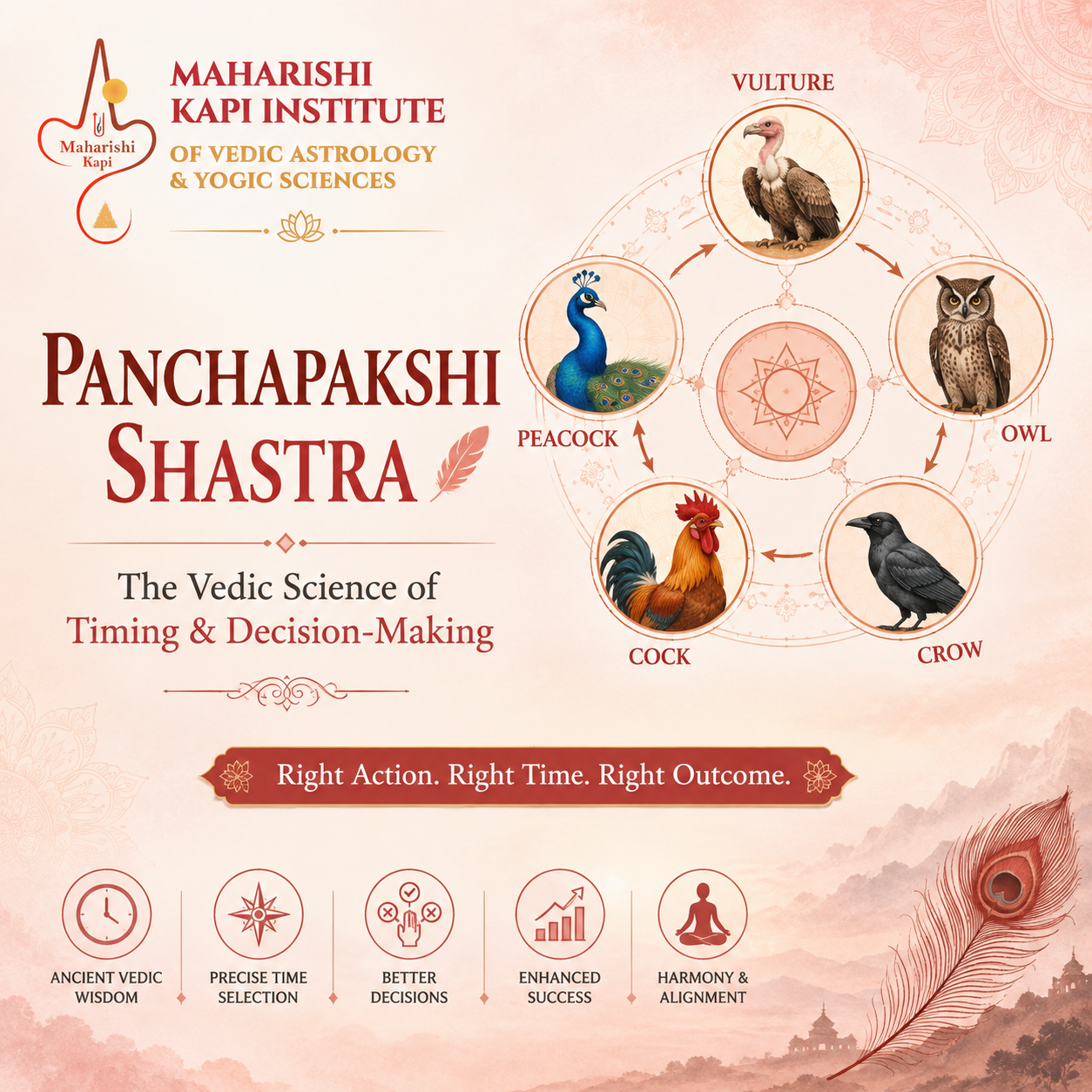
Panchapakshi Shastra is a specialised traditional system used to study the changing strength of time through the activities of five symbolic birds. The word Panchapakshi combines Pancha, meaning five, and Pakshi, meaning bird.
The system associates individuals and time periods with five birds:
- Vulture
- Owl
- Crow
- Cock
- Peacock
Each bird continuously moves through five activities—Ruling, Eating, Walking, Sleeping, and Dying—with every activity carrying a different degree of strength and effectiveness.
The Panchapakshi Shastra course at Maharishi Kapi Institute of Vedic Astrology & Yogic Sciences introduces students to the foundations, calculations, timing principles, and practical applications of this distinctive system.
Students will learn how Panchapakshi principles may be applied traditionally to travel, health-related enquiries, compatibility, horary questions, daily decisions, and the selection of supportive periods for important actions.
Why Study Panchapakshi Shastra?
In many situations, the question is not merely what will happen, but also:
- When should an action be initiated?
- Which period is more supportive?
- When should an important conversation take place?
- Is the present moment favourable for travel or decision-making?
- Which time period carries greater strength?
- How should a horary question be assessed?
Panchapakshi Shastra provides a systematic framework for studying the qualitative strength of time.
Rather than treating every hour as equal, it helps the practitioner recognise changing periods of activity, rest, dominance, weakness, and transition.
What You Will Learn
Module 1 – Foundations of Panchapakshi Shastra
Develop a clear understanding of the origin, structure, and purpose of the system.
Topics include:
- Meaning of Panchapakshi
- Traditional Basis of Panchapakshi Shastra
- Philosophy Behind the Five-Bird System
- Relationship with Nakshatras
- Relationship with the Lunar Cycle
- Role of Shukla Paksha and Krishna Paksha
- Panchapakshi as a System of Timing
- Scope and Limitations of the Method
Module 2 – The Five Birds of Panchapakshi
Study the nature and characteristics of the five principal birds.
Detailed study of:
- Vulture
- Owl
- Crow
- Cock
- Peacock
For every bird, students will examine:
- Fundamental Nature
- Symbolic Significance
- Behavioural Characteristics
- Strengths and Weaknesses
- Functional Role
- Relationship with Time
- Practical Importance in Interpretation
Module 3 – The Five Activities of Panchapakshi
Understand the five activities through which every bird operates.
The activities include:
- Ruling
- Eating
- Walking
- Sleeping
- Dying
Students will learn:
- Meaning of Each Activity
- Relative Strength of Activities
- Favourable and Unfavourable Conditions
- Active and Passive States
- Interpretation of Strong and Weak Periods
- Practical Use in Decision-Making
Module 4 – Functions, Characteristics and Features
Study the complete working mechanism of Panchapakshi Shastra.
Topics include:
- Functions of Panchapakshi
- Characteristics of Each Bird
- Features of the Panchapakshi System
- Relationship Between Bird and Activity
- Natural Strength of Different Activities
- Functional Strength During Different Periods
- Interaction Between Birds
- Interpretation of Dominant and Weak States
Module 5 – Panchapakshi During Shukla Paksha
Understand how the activities and sequence of the birds operate during the waxing phase of the Moon.
Topics include:
- Meaning of Shukla Paksha
- Panchapakshi Sequence in Shukla Paksha
- Day and Night Considerations
- Activity Cycles
- Strength of Different Birds
- Practical Calculation
- Interpretation of Favourable Periods
Module 6 – Panchapakshi During Krishna Paksha
Study the functioning of Panchapakshi during the waning phase of the Moon.
Topics include:
- Meaning of Krishna Paksha
- Panchapakshi Sequence in Krishna Paksha
- Day and Night Calculations
- Changes in Bird Activities
- Comparative Strength
- Practical Calculation
- Interpretation and Application
Module 7 – Timing and Strength of Activities
Learn how to calculate when each activity begins and ends.
Topics include:
- Division of Day and Night
- Duration of Activities
- Activity Timings
- Strength of Panchapakshi
- Primary and Sub-Activities
- Strong, Moderate and Weak Periods
- Selection of Supportive Time
- Avoidance of Weak Periods
- Practical Timing Exercises
Module 8 – Determination of the Birth Bird
Learn the method used to identify an individual’s Janma Pakshi or birth bird.
Topics include:
- Role of Birth Nakshatra
- Nakshatra Classification
- Shukla and Krishna Paksha Considerations
- Determination of Janma Pakshi
- Personal Bird Characteristics
- Relationship Between Birth Bird and Daily Activities
- Supportive and Challenging Periods
- Practical Birth-Bird Calculations
Practical Applications of Panchapakshi Shastra
Module 9 – Travel and Important Movements
Understand how Panchapakshi may be applied traditionally when selecting time for travel.
Topics include:
- Timing a Journey
- Beginning Important Travel
- Short and Long-Distance Travel
- Business-Related Travel
- Evaluating the Strength of the Birth Bird
- Supportive and Weak Activity Periods
- Practical Travel Case Studies
Module 10 – Health and Disease-Related Enquiries
Study the traditional application of Panchapakshi in health-related questions.
Topics include:
- Evaluating a Health Enquiry
- Strength of the Native’s Bird
- Active and Inactive Periods
- Timing Supportive Actions
- Indications of Strength and Weakness
- Horary Considerations
- Ethical Interpretation of Health Questions
This module is taught as a traditional astrological framework and not as a substitute for medical diagnosis or treatment.
Module 11 – Panchapakshi and Horary Astrology
Learn how the system can be applied when analysing a specific question.
Topics include:
- Introduction to Horary Application
- Time of the Query
- Bird Active at the Time of Question
- Activity of the Birth Bird
- Strength of the Relevant Period
- Positive and Negative Indications
- Assessing the Likely Direction of an Enquiry
- Practical Horary Examples
Module 12 – Nakshatra and Query Analysis
Understand the relationship between Nakshatra, timing, and the nature of a question.
Topics include:
- Nakshatra at the Time of Query
- Birth Nakshatra of the Querent
- Nature of the Question
- Relationship Between Query and Bird
- Activity-Based Interpretation
- Combining Nakshatra and Panchapakshi
- Practical Question Analysis
Module 13 – Compatibility and Matching
Study the traditional use of Panchapakshi principles in compatibility assessment.
Topics include:
- Identification of the Birds of Two Individuals
- Natural Relationship Between Birds
- Friendly and Challenging Combinations
- Comparative Strength
- Relationship Dynamics
- Marriage Matching
- Professional and Business Compatibility
- Practical Matching Exercises
Module 14 – Applied Panchapakshi Shastra
Bring all course principles together through guided practical training.
Applications include:
- Starting Important Work
- Business Decisions
- Meetings and Negotiations
- Travel
- Relationship Discussions
- Horary Questions
- Health-Related Enquiries
- Compatibility Assessment
- Daily Activity Planning
- Selection of Supportive Periods
Students will learn how to apply the system thoughtfully rather than relying on isolated tables or mechanical calculation.
Practical Training
This course combines theoretical study with guided application.
Practical training includes:
- Determination of the Birth Bird
- Shukla Paksha Calculations
- Krishna Paksha Calculations
- Day and Night Activity Tables
- Strength Assessment
- Travel Timing Exercises
- Horary Case Studies
- Compatibility Analysis
- Query-Based Interpretation
- Real-Life Application Discussions
Students will be encouraged to maintain observation records and compare Panchapakshi timings with actual outcomes.
Learning Outcomes
By the end of the course, students will be able to:
- Understand the foundations of Panchapakshi Shastra
- Identify the five birds and their characteristics
- Interpret the five principal activities
- Determine an individual’s birth bird
- Calculate bird activities during Shukla and Krishna Paksha
- Evaluate the comparative strength of different periods
- Apply Panchapakshi principles to travel and daily decisions
- Analyse traditional health-related and horary enquiries
- Use Nakshatra considerations in query analysis
- Assess compatibility through the five-bird system
- Integrate Panchapakshi into astrological consultation
Learning Methodology
At Maharishi Kapi Institute of Vedic Astrology & Yogic Sciences, Panchapakshi Shastra is taught through a structured combination of traditional principles, calculation, observation, and practical application.
Students learn through:
- Live Conceptual Teaching
- Step-by-Step Calculations
- Activity Tables
- Practical Demonstrations
- Case-Based Discussions
- Guided Exercises
- Observation Assignments
- Faculty Support
The objective is to help students understand not only how the system is calculated, but also how it may be interpreted responsibly in practical situations.
Course Includes
- Live Interactive Online Classes on Zoom
- Access to Class Recordings
- Comprehensive Course PPT
- Panchapakshi Calculation Tables
- Birth-Bird Determination Charts
- Shukla and Krishna Paksha Reference Material
- Practical Case Studies
- Guided Assignments
- Certificate of Completion
- Academic and Faculty Support
Why Learn at Maharishi Kapi Institute?
The Maharishi Kapi Institute of Vedic Astrology & Yogic Sciences is dedicated to preserving specialised branches of Vedic and traditional Indian knowledge through structured, accessible, and application-oriented education.
Under the guidance of Acharya Alok Awasthi, students are introduced to Panchapakshi Shastra as a disciplined system of timing and observation. The course focuses on conceptual clarity, accurate calculation, practical application, and responsible interpretation.
Rather than presenting the subject as a collection of fixed predictions, students are trained to understand the dynamic relationship between time, Nakshatra, lunar phase, individual nature, and the activity of the five birds.
Certification
Upon successful completion of the course, students receive a: Certificate in Panchapakshi Shastra
The Vedic Science of Timing & Decision-Making Issued by Maharishi Kapi Institute of Vedic Astrology & Yogic Sciences.
Student Support
For admissions, course guidance, or technical assistance, contact:
Email: maharishikapi@gmail.com
Helpline: +91-8791691675
Explore More Professional Programs
Continue your study through our specialised programs in:
- Vedic Astrology
- Nakshatra Vidya
- Predictive Astrology
- Medical Astrology
- Horary Astrology
- Muhurta
- Vedic Numerology
- Palmistry
- Face Reading
- Vastu Shastra
- Tarot
- Ayurveda
- Bhagavad Gita
- Vedanta and Vedic Philosophy
- Marma Therapy
- Meditation
- Yogic Counselling
Every program is designed to integrate classical knowledge, practical application, ethical interpretation, and meaningful personal development.
Educational Disclaimer
Panchapakshi Shastra is a traditional system of timing and astrological interpretation taught for educational and research purposes. Its applications should not replace professional medical, legal, financial, psychological, or other qualified expert advice.