Mastering Vedic Vastu for Homes, Properties & Conscious Living
Programme Overview
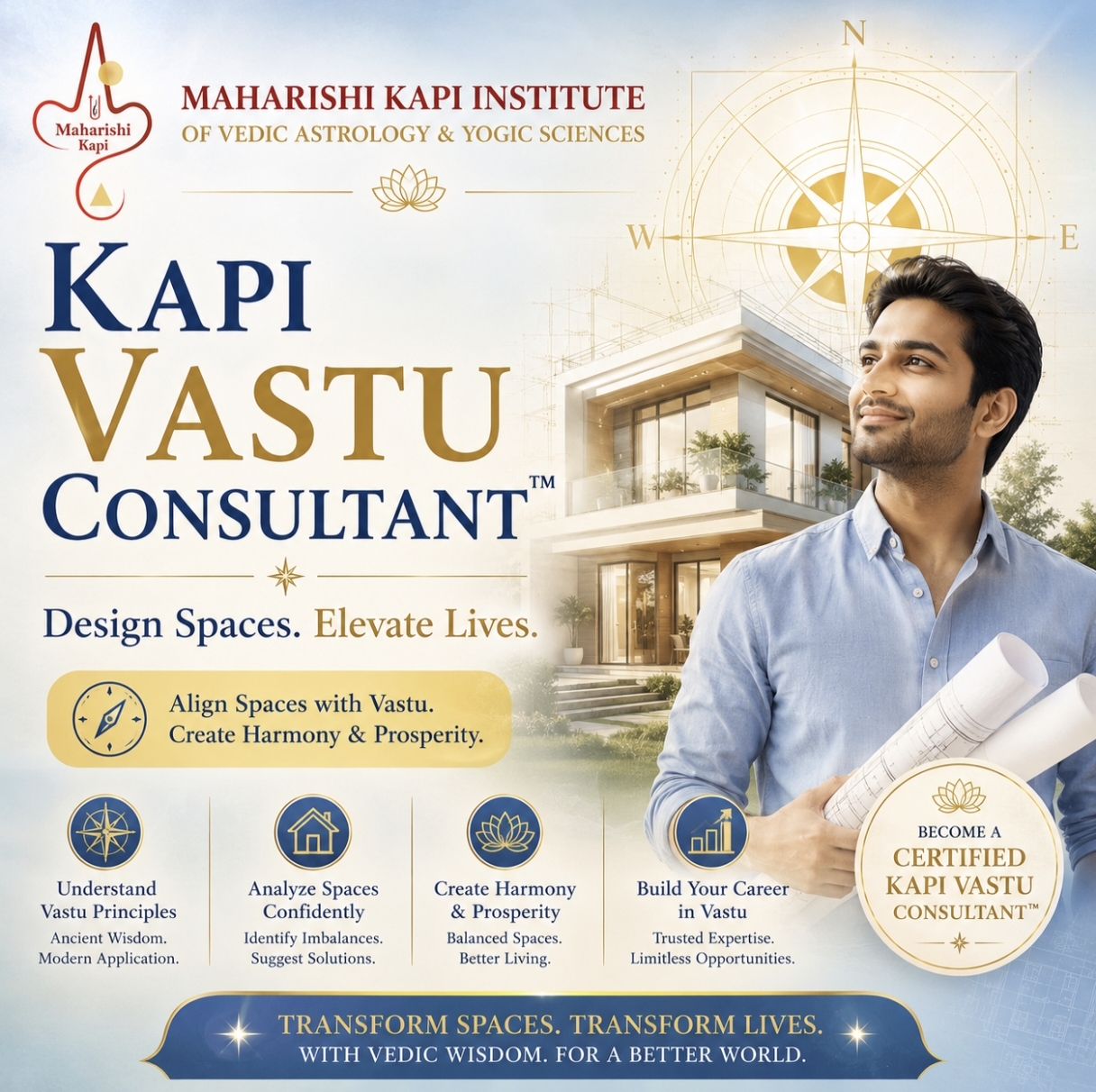
Kapi Vastu Consultant™ is a comprehensive professional programme designed to establish a strong foundation in the principles, philosophy and practical application of Vastu Shastra.
The programme combines classical Vastu concepts with a systematic consultation methodology, enabling students to understand land, directions, elements, spatial zones, Vastu Purusha Mandala and architectural planning and apply these principles to real-world residential and basic commercial spaces.
Rather than encouraging students to memorise isolated rules, the programme teaches them how to observe, analyse, prioritise and communicate Vastu recommendations professionally.
What You Will Learn
- Vastu Shastra Fundamentals – Understand the origin, philosophy, principles and practical purpose of Vastu Shastra.
- Pancha Mahabhuta – Study the five elements—Prithvi, Jala, Agni, Vayu and Akasha—and their relationship with space and human life.
- Directions & Energy Zones – Understand cardinal and intercardinal directions, their characteristics and their role in spatial planning.
- Vastu Purusha Mandala – Learn the fundamental Vastu grid and its application in analysing plots, buildings and individual spaces.
- Site & Plot Analysis – Evaluate plot shape, orientation, slope, roads, surroundings, open spaces and other important site characteristics.
- Residential Vastu – Analyse entrances, bedrooms, kitchens, living spaces, bathrooms, staircases, study areas, prayer spaces and other residential zones.
- Basic Commercial Vastu – Understand the foundational Vastu principles applicable to offices, shops, studios, clinics and small business spaces.
- Vastu Defects & Corrections – Learn how to identify significant spatial imbalances and develop practical, proportionate correction strategies.
- Professional Consultation – Learn how to conduct a Vastu consultation systematically—from client briefing and site assessment to recommendations and report preparation.
COURSE CURRICULUM
MODULE 1 — Foundations of Vastu Shastra
Understanding the Vedic Science of Space
- Meaning and definition of Vastu
- Origin and historical development of Vastu Shastra
- Vastu within the Vedic knowledge tradition
- Purpose and philosophy of Vastu
- Relationship between Vastu and architecture
- Relationship between humans, nature and built environments
- Traditional Vastu principles
- Classical vs contemporary approaches
- Common misconceptions about Vastu
- Scope and limitations of Vastu consultancy
Learning Objective
Develop a clear conceptual understanding of what Vastu is, what it is intended to accomplish and how it should be approached responsibly.
MODULE 2 — Pancha Mahabhuta
The Five Elements & Spatial Harmony
- Prithvi — Earth
- Jala — Water
- Agni — Fire
- Vayu — Air
- Akasha — Ether/Space
- Qualities of the five elements
- Elemental relationships
- Elemental balance and imbalance
- Elements and directions
- Elements and spatial functions
- Elemental influence within built environments
- Recognising elemental characteristics within a property
Practical Exercise
Pancha Mahabhuta Mapping of a Property
MODULE 3 — Directions & Spatial Orientation
Understanding the Vastu Compass
- Cardinal directions
- Intercardinal directions
- North
- South
- East
- West
- Northeast
- Southeast
- Southwest
- Northwest
- Centre / Brahmasthana
- Directional characteristics
- Directional functionality
- Elemental associations
- Understanding orientation
- Magnetic direction vs architectural orientation
- Using a compass for Vastu assessment
Practical Exercise
Prepare a complete directional map of a property.
MODULE 4 — Vastu Purusha Mandala
The Sacred Planning Grid
- Concept of Vastu Purusha
- Symbolism of Vastu Purusha
- Vastu Purusha Mandala
- Structure of the Mandala
- Basic grid divisions
- Padas and spatial divisions
- Centre and peripheral zones
- Brahmasthana
- Relationship between Mandala and architecture
- Applying the Mandala to a plot
- Applying the Mandala to a building
Practical Exercise
Overlay and interpret a Vastu Purusha Mandala on sample floor plans.
MODULE 5 — Land & Plot Vastu
Understanding the Property Before the Building
- Importance of site selection
- Plot orientation
- Plot shape
- Square plots
- Rectangular plots
- Irregular plots
- Extensions and reductions
- Cut corners
- Plot proportions
- Land slope
- Levels and elevation
- Roads surrounding the property
- Entry roads
- Open spaces
- Adjacent buildings
- Natural surroundings
- Water bodies
- External environmental factors
Practical Exercise
Complete a Basic Plot Vastu Assessment.
MODULE 6 — Spatial Zoning & Functional Placement
Understanding How Space Should Be Used
- Directional zones
- Elemental zones
- Heavy and light zones
- Open and closed areas
- Active and passive spaces
- Movement and circulation
- Functional zoning
- Appropriate spatial functions
- Inappropriate spatial functions
- Weight distribution
- Light distribution
- Basic principles of spatial balance
Practical Exercise
Create a functional Vastu zoning plan for a residential property.
MODULE 7 — Residential Vastu
Vastu for Homes & Living Spaces
Main Entrance –
- Importance of the entrance
- Entrance direction
- Basic entrance placement
- Door positioning
- Door alignment
- Entrance surroundings
Major Residential Spaces –
- Living room
- Master bedroom
- Children’s bedroom
- Guest bedroom
- Kitchen
- Dining area
- Study room
- Puja/meditation space
- Bathrooms
- Toilets
- Staircases
- Balconies
- Windows
- Storage
- Utility areas
Additional Considerations –
- Sleeping orientation
- Cooking orientation
- Basic furniture placement
- Natural light
- Ventilation
- Open spaces
- Internal circulation
Practical Exercise
Complete Residential Floor-Plan Analysis
MODULE 8 — Apartment & Urban Residential Vastu
Modern properties require a separate analytical approach.
- Apartment Vastu fundamentals
- High-rise living
- Entrance analysis
- Individual apartment orientation
- Floor-level considerations
- Balcony placement
- Kitchen and bedroom analysis
- Common areas
- Lift and staircase considerations
- Shared building spaces
- Limitations of apartment-level corrections
- Practical correction strategies for rented properties
Case Study
Analyse a modern apartment floor plan.
MODULE 9 — Basic Commercial Vastu
Introduction to Vastu for Business Spaces
This module introduces commercial Vastu without entering the advanced commercial, industrial and institutional systems reserved for Kapi Vastu Master Practitioner™.
- Office spaces
- Shops
- Studios
- Small clinics
- Consultation rooms
- Reception areas
- Workstations
- Owner/management area
- Storage
- Customer movement
- Cash and transaction areas
- Basic entrance principles
- Employee seating
- Productivity-oriented spatial planning
- Basic business-space assessment
Practical Exercise
Analyse a small commercial floor plan.
MODULE 10 — Understanding Vastu Defects
From Rule-Based Thinking to Professional Analysis
- What is a Vastu defect?
- Major vs minor concerns
- Structural vs functional concerns
- Directional imbalance
- Elemental imbalance
- Zone-related concerns
- Entrance-related concerns
- Brahmasthana concerns
- Plot-related concerns
- External environmental concerns
- Severity and prioritisation
- Avoiding unnecessary fear-based interpretations
Kapi Principle –
A Vastu deviation should be evaluated in context—not every deviation should automatically be treated as a major defect.
MODULE 11 — Vastu Corrections & Remedial Principles
Correcting Space with Intelligence
- Correction vs remedy
- Structural correction
- Functional correction
- Spatial redistribution
- Elemental balancing
- Light and ventilation
- Colour principles
- Natural materials
- Decluttering
- Furniture and weight management
- Symbolic corrections
- Non-structural corrections
- Practical corrections for rented properties
- Prioritising corrections
- Cost-conscious remedial planning
Important
Advanced Vastu Devata remedies, Numero Vastu, Astro-Vastu and advanced remedial systems are intentionally reserved for the subsequent Kapi Vastu programmes.
MODULE 12 — Vastu & Conscious Living
Integrating Vastu into Everyday Life
- Vastu and lifestyle
- Conscious use of space
- Cleanliness and order
- Natural light
- Air circulation
- Sleeping environment
- Working environment
- Study environment
- Meditation environment
- Food and kitchen environment
- Personal space
- Relationship between behaviour and environment
- Creating harmonious living spaces
MODULE 13 — The Kapi Vastu Consultation Method™
From Observation to Professional Recommendation
Students learn a structured consultation process:
Step 1 — Client Briefing
Understand the client’s concerns, objectives and property history.
Step 2 — Property Documentation
Collect floor plans, dimensions, photographs, orientation and relevant information.
Step 3 — Orientation
Establish the accurate directional framework.
Step 4 — Site Analysis
Evaluate the plot, surroundings, access and external environment.
Step 5 — Mandala Mapping
Apply the appropriate Vastu grid.
Step 6 — Zone Analysis
Evaluate major directional and elemental zones.
Step 7 — Functional Analysis
Assess the placement and use of rooms and activities.
Step 8 — Defect Identification
Identify significant deviations and imbalances.
Step 9 — Prioritisation
Separate critical observations from secondary recommendations.
Step 10 — Correction Strategy
Develop practical and proportionate recommendations.
Step 11 — Client Communication
Explain findings clearly without creating unnecessary fear.
Step 12 — Professional Report
Prepare a structured Vastu consultation report.
MODULE 14 — Practical Case Studies
Students will work through real-world-style case studies involving:
Case Study 1
Residential Plot
Case Study 2
Independent House
Case Study 3
Urban Apartment
Case Study 4
Small Office
Case Study 5
Retail / Commercial Space
Case Study 6
Vastu-Deficient Floor Plan
For each case, students practise –
Observation → Analysis → Prioritisation → Recommendation → Report
MODULE 15 — Professional Vastu Practice
Becoming a Responsible Vastu Consultant
- Client communication
- Consultation etiquette
- Professional boundaries
- Ethical Vastu practice
- Avoiding fear-based consultation
- Communicating uncertainty
- Managing client expectations
- Documentation
- Confidentiality
- Consultation reports
- Basic consultation pricing principles
- Follow-up consultations
- Building professional credibility
- Case documentation
- Developing a Vastu consultancy practice
FINAL PRACTICAL ASSESSMENT
To successfully complete Kapi Vastu Consultant™, students should demonstrate their ability to:
- Analyse a plot
- Establish orientation
- Apply the Vastu Purusha Mandala
- Analyse elemental and directional zones
- Evaluate a residential floor plan
- Analyse a basic commercial property
- Identify significant Vastu concerns
- Prioritise recommendations
- Develop practical corrections
- Conduct a structured consultation
- Prepare a professional Vastu report
By the end of the programme, you will be able to –
- Understand the fundamental principles of Vastu Shastra.
- Analyse directions, elements and spatial zones.
- Apply the Vastu Purusha Mandala.
- Evaluate plots and surrounding environments.
- Analyse residential properties and apartments.
- Conduct introductory commercial Vastu assessments.
- Identify and prioritise significant Vastu concerns.
- Recommend practical and proportionate corrections.
- Conduct a structured Vastu consultation.
- Prepare professional Vastu assessment reports.
- Communicate Vastu recommendations ethically and responsibly.
CERTIFICATION
Upon successful completion of the programme, practical assignments and final assessment, participants will receive:
Kapi Vastu Consultant™
Professional Certification by Maharishi Kapi Institute of Vedic Astrology & Yogic Sciences
WHAT COMES NEXT?
Students who wish to advance their expertise can progress to:
Kapi Vastu Devta™
Mastering Vastu Devatas, Energy Fields & Numero Vastu
An advanced specialist programme exploring the deeper dimensions of Vastu Devatas, Mandala-based energy analysis and Numero Vastu.
↓
Kapi Vastu Master Practitioner™
Advanced Multi-Domain Vastu Consultancy & Strategic Advisory
The capstone programme covering advanced residential, commercial, industrial, institutional, hospitality, wellness and large-scale Vastu consultancy, together with integrated specialist methodologies.
Kapi Vastu™ Professional Path
Kapi Vastu Consultant™
Learn → Analyse → Consult
↓
Kapi Vastu Devta™
Understand → Integrate → Specialise
↓
Kapi Vastu Master Practitioner™
Master → Strategise → Advise