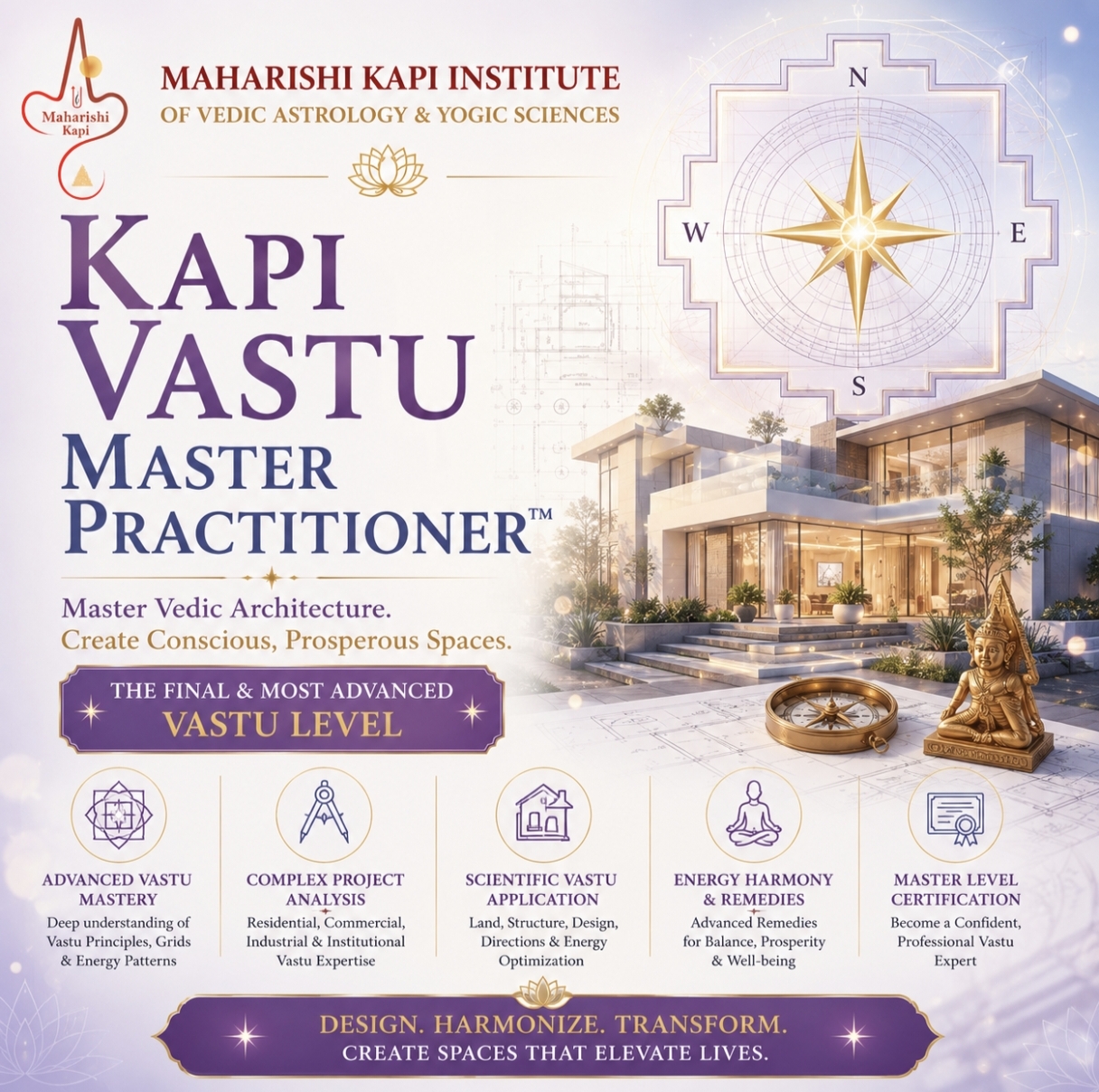
Kapi Vastu Master Practitioner™

By Acharya Alok Awasthi

Original price was: $499.00.Current price is: $360.00.

Advanced Multi-Domain Vastu Consultancy & Strategic Advisory

Mastering Complex Spaces, Advanced Vastu Applications & Strategic Spatial Design


Programme Overview

Kapi Vastu Master Practitioner™ is the highest and most comprehensive programme in the Kapi Vastu professional education pathway.

Designed for practitioners who have completed Kapi Vastu Consultant™ and Kapi Vastu Devta™, this capstone programme focuses on the application of Vastu principles to complex properties, commercial environments, industrial facilities, institutions, hospitality spaces, wellness environments and large-scale developments.

The programme moves beyond basic Vastu diagnosis and specialist Devata analysis into strategic consultancy.

Students learn how to assess complex environments, prioritise multiple Vastu considerations, develop practical intervention strategies, communicate recommendations to clients and work on professional projects with greater confidence and structure.


THE KAPI VASTU MASTER PRACTITIONER APPROACH

At the Master Practitioner level, Vastu is not treated as a checklist of isolated rules.

Students learn to approach a property through multiple analytical layers:

Layer 1 — Site

Plot, orientation, surroundings, access and environmental context.

Layer 2 — Architecture

Building form, circulation, entrances, levels, proportions and functional planning.

Layer 3 — Vastu

Directions, zones, elements, Mandala and spatial relationships.

Layer 4 — Devata

Vastu Purusha Mandala and Devata-based interpretation.

Layer 5 — Astro-Vastu

Where appropriate, integrating the individual’s or organisation’s astrological framework.

Layer 6 — Numero Vastu

Property, business and relevant numerical considerations.

Layer 7 — Function

The actual purpose and operational requirements of the space.

Layer 8 — Strategy

Prioritising interventions according to practicality, significance and client requirements.

This creates a multi-dimensional consultancy methodology rather than a one-rule-one-remedy approach.


WHAT YOU WILL MASTER

Advanced Residential Vastu

Complex homes, apartments, villas, irregular plots and challenging configurations.

Commercial Vastu

Offices, retail spaces, restaurants, hotels, clinics and wellness businesses.

Industrial Vastu

Factories, manufacturing facilities, warehouses, machinery layouts and industrial sites.

Institutional Vastu

Hospitals, educational institutions, corporate campuses, spiritual centres and large facilities.

Astro-Vastu

Integrating Vastu analysis with planetary and horoscope-based considerations.

Advanced Remedial Strategy

Developing proportionate, practical and context-sensitive interventions.

Strategic Vastu Consultancy

Working with complex client requirements and developing professional advisory reports.

Large-Scale Vastu Projects

Understanding the methodology required for campuses, developments and multi-building environments.


COURSE CURRICULUM

MODULE 1 — Master Practitioner Framework

From Vastu Consultant to Strategic Advisor

  • Evolution of Vastu consultancy
  • Difference between consultant and Master Practitioner
  • Multi-layered Vastu analysis
  • Analytical hierarchy
  • Identifying primary vs secondary concerns
  • Prioritising Vastu observations
  • Working with conflicting Vastu factors
  • Balancing traditional principles with modern requirements
  • Functional considerations in Vastu
  • Client objectives and spatial requirements
  • Professional decision-making
  • Developing a consistent consultation methodology

Master Practitioner Principle

Do not analyse a property through one isolated rule. Analyse the system as a whole.


MODULE 2 — Advanced Site & Plot Analysis

Reading the Land Before the Building

  • Advanced plot analysis
  • Orientation
  • Plot geometry
  • Regular and irregular plots
  • Extensions and cut-outs
  • Sloping sites
  • Levels and contours
  • Road placement
  • Approaches and access
  • Surrounding structures
  • Adjacent properties
  • Natural environmental influences
  • Water bodies
  • Open spaces
  • Landscape considerations
  • Site selection principles
  • Development potential
  • Advanced site assessment methodology

Practical Exercise

Complete a full site and plot feasibility assessment.


MODULE 3 — Advanced Residential Vastu

Complex Homes & Challenging Configurations

  • Independent houses
  • Villas
  • Apartments
  • Duplexes
  • Multi-storey residences
  • Irregular floor plans
  • Split-level homes
  • Basement considerations
  • Rooftop spaces
  • Multiple entrances
  • Internal circulation
  • Staircases
  • Bedrooms
  • Kitchens
  • Bathrooms
  • Study spaces
  • Pooja and meditation areas
  • Home offices
  • Garages and parking
  • Modern architectural constraints

Advanced Casework

Students analyse residential properties where multiple Vastu considerations conflict with practical architectural requirements.


MODULE 4 — Commercial Vastu

Vastu for Business & Customer-Oriented Spaces

Offices –

  • Reception
  • Leadership spaces
  • Employee areas
  • Meeting rooms
  • Finance departments
  • Records and storage
  • Communication and circulation

Retail –

  • Entrance
  • Display areas
  • Customer movement
  • Billing counters
  • Storage
  • Staff areas

Restaurants & Cafés –

  • Entrance
  • Kitchen
  • Dining areas
  • Service flow
  • Cash counter
  • Storage
  • Utilities

Clinics & Professional Practices –

  • Reception
  • Consultation rooms
  • Treatment spaces
  • Waiting areas
  • Administration
  • Storage

Hotels & Hospitality –

  • Main entrance
  • Lobby
  • Guest rooms
  • Restaurants
  • Kitchens
  • Service areas
  • Administrative spaces
  • Back-of-house planning

MODULE 5 — Industrial Vastu

Vastu for Factories, Manufacturing & Industrial Systems

This module introduces the practitioner to the substantially different requirements of industrial environments.

Industrial Site Planning –

  • Factory site selection
  • Plot orientation
  • Access and movement
  • Loading and unloading
  • Internal circulation
  • Open and restricted zones

Manufacturing Areas –

  • Production zones
  • Machinery placement
  • Heavy equipment
  • Assembly areas
  • Processing areas
  • Operational flow

Supporting Infrastructure –

  • Warehouses
  • Raw-material storage
  • Finished-goods storage
  • Administrative blocks
  • Worker facilities
  • Utilities
  • Maintenance areas

Fire & High-Energy Zones –

  • Heat-generating equipment
  • Electrical infrastructure
  • Boilers and furnaces
  • Fire-related areas
  • High-risk operational zones

Strategic Objective

Understand how Vastu principles can be considered alongside safety, engineering, workflow, compliance and operational realities.


MODULE 6 — Institutional Vastu

Large & Multi-Functional Environments

  • Educational institutions
  • Schools
  • Universities
  • Training centres
  • Hospitals
  • Healthcare facilities
  • Corporate campuses
  • Government buildings
  • Spiritual institutions
  • Retreat centres
  • Research facilities
  • Wellness centres

Institutional Planning

  • Main entrance
  • Administration
  • Public areas
  • Staff areas
  • Residential areas
  • Service zones
  • Circulation
  • Open spaces
  • Central areas
  • Functional zoning

Advanced Principle

The larger the building, the more important it becomes to understand hierarchy, circulation, functional zoning and operational requirements, rather than applying residential Vastu rules mechanically.


MODULE 7 — Hospitality, Wellness & Healing Spaces

Designing Environments for Rest, Recovery & Conscious Living 

  • Hotels
  • Retreat centres
  • Yoga centres
  • Meditation spaces
  • Ayurveda centres
  • Panchakarma facilities
  • Wellness clinics
  • Spa environments
  • Healing rooms
  • Therapy spaces
  • Residential retreats

Wellness-Space Principles –

  • Reception and arrival experience
  • Treatment areas
  • Meditation spaces
  • Yoga halls
  • Rest areas
  • Water features
  • Natural light
  • Ventilation
  • Landscape
  • Quiet zones
  • Movement and circulation

Practical Exercise

Develop a Vastu strategy for a wellness or retreat facility.


MODULE 8 — Astro-Vastu

Integrating Jyotisha with Spatial Analysis

A specialist module connecting the practitioner’s knowledge of Vastu with Vedic astrology.

  • Philosophy of Astro-Vastu
  • Relationship between individual and environment
  • Planetary symbolism and spatial principles
  • Horoscope-based spatial analysis
  • Ascendant and directional considerations
  • Planetary influences
  • House-specific considerations
  • Property and life-area relationships
  • Individualised Vastu interpretation
  • When Astro-Vastu is appropriate
  • Limitations of horoscope-based Vastu recommendations
  • Integrating Astro-Vastu without replacing core Vastu analysis

Practical Case Study

Develop an integrated Astro-Vastu assessment using a birth chart and property plan.


MODULE 9 — Advanced Numero Vastu

Numbers, Property & Strategic Compatibility

Building upon the specialist knowledge acquired in Kapi Vastu Devta™.

  • Advanced property-number analysis
  • Business-number analysis
  • Name and property compatibility
  • Business name and premises
  • Owner and business compatibility
  • Numerical selection principles
  • Apartment and unit numbers
  • Floor numbers
  • Office numbers
  • Commercial property numbers
  • Number selection for new developments
  • Integrating numerical analysis with Vastu
  • Avoiding over-reliance on numerical factors

Practical Exercise

Complete an integrated Vastu + Numero Vastu business assessment.


MODULE 10 — Advanced Vastu Remedial Science

From Diagnosis to Intervention

This is one of the most important Master Practitioner modules.

Students learn to distinguish between:

Observation → Diagnosis → Priority → Intervention → Evaluation

Remedial Categories

  • Architectural corrections
  • Functional corrections
  • Spatial reorganisation
  • Elemental balancing
  • Environmental modifications
  • Colour considerations
  • Lighting
  • Landscape
  • Movement and circulation
  • Symbolic interventions
  • Traditional Vastu remedies
  • Devata-oriented considerations
  • Appropriate use of Vastu tools and objects
  • Remedial hierarchy
  • Minimal-intervention philosophy

Critical Principle

A remedy should address an identified issue; remedies should not be prescribed simply because they are available.


MODULE 11 — Vastu for Large-Scale Developments

Master Planning & Multi-Building Environments

  • Residential developments
  • Apartment complexes
  • Townships
  • Corporate campuses
  • Educational campuses
  • Hospital campuses
  • Retreat centres
  • Industrial estates
  • Mixed-use developments

Planning Considerations –

  • Overall orientation
  • Master site grid
  • Entry and exit
  • Internal roads
  • Functional zoning
  • Open spaces
  • Landscape
  • Water systems
  • Utilities
  • Building hierarchy
  • Central spaces
  • Movement patterns
  • Multiple structures
  • Relationship between buildings

Practical Exercise

Prepare a conceptual Vastu framework for a multi-building development.


MODULE 12 — Vastu & Modern Architecture

Applying Traditional Principles to Contemporary Buildings

  • Glass structures
  • Steel structures
  • High-rise buildings
  • Apartments
  • Compact urban homes
  • Open-plan offices
  • Underground spaces
  • Mixed-use buildings
  • Modern HVAC systems
  • Mechanical ventilation
  • Smart buildings
  • Contemporary materials
  • Artificial lighting
  • Limited natural ventilation
  • Adaptive reuse

Master Practitioner Skill

Learn how to preserve the principle behind a traditional Vastu concept while working within modern architectural constraints.


MODULE 13 — Vastu & Environmental Design

Space, Nature & Human Experience

  • Natural light
  • Ventilation
  • Thermal comfort
  • Landscape
  • Vegetation
  • Water
  • Noise
  • Privacy
  • Movement
  • Views
  • Open space
  • Environmental context
  • Human experience
  • Conscious architectural planning

This module connects Vastu thinking with broader principles of environmental and human-centred design.


MODULE 14 — Advanced Project Diagnosis

The Master Practitioner Diagnostic System

Students learn a structured process for complex projects.

STEP 1

Understand the client’s objective.

STEP 2

Collect site and architectural information.

STEP 3

Establish orientation and site framework.

STEP 4

Map the Vastu Purusha Mandala.

STEP 5

Analyse functional zoning.

STEP 6

Evaluate directional and elemental relationships.

STEP 7

Apply Devata analysis where appropriate.

STEP 8

Evaluate numerical considerations.

STEP 9

Apply Astro-Vastu where relevant.

STEP 10

Identify major and minor concerns.

STEP 11

Prioritise interventions.

STEP 12

Develop practical recommendations.

STEP 13

Prepare the professional report.

STEP 14

Present recommendations to the client.


MODULE 15 — Advanced Vastu Consultancy & Strategic Advisory

Working as a Professional Master Practitioner

  • Client discovery
  • Consultation structure
  • Project briefing
  • Site visits
  • Architectural collaboration
  • Working with architects and engineers
  • Working with builders and developers
  • Working with business owners
  • Institutional consultations
  • Corporate advisory
  • Presenting technical observations
  • Explaining traditional principles
  • Handling client objections
  • Managing expectations
  • Professional boundaries
  • Documentation
  • Confidentiality
  • Consultation agreements
  • Scope of work
  • Professional fees
  • Project-based consultancy
  • Follow-up assessments

MODULE 16 — Advanced Case Studies

Students undertake comprehensive projects across multiple domains.

Case Study 1

Complex Residential Property

Case Study 2

Luxury Villa & Irregular Plot

Case Study 3

Commercial Office

Case Study 4

Hotel & Hospitality Property

Case Study 5

Hospital / Healthcare Facility

Case Study 6

Educational Institution

Case Study 7

Factory & Manufacturing Facility

Case Study 8

Warehouse & Logistics Facility

Case Study 9

Wellness & Retreat Centre

Case Study 10

Large Multi-Building Development

Each case follows the complete Master Practitioner methodology:

Survey → Map → Diagnose → Prioritise → Strategise → Recommend → Document → Present


MODULE 17 — MASTER PRACTITIONER CAPSTONE PROJECT

Complete Professional Vastu Consultancy

Students must select or receive a substantial property/project and complete an end-to-end consultancy.

Required Components

1. Client Brief

2. Site & Property Documentation

3. Orientation & Site Analysis

4. Vastu Purusha Mandala

5. Functional Zoning Analysis

6. Directional & Elemental Analysis

7. Devata Analysis

8. Numero Vastu Analysis

9. Astro-Vastu Analysis where applicable

10. Identification of Primary Concerns

11. Remedial Strategy

12. Prioritised Recommendations

13. Professional Vastu Report

14. Client Presentation

15. Final Faculty Review


PROFESSIONAL PRACTICAL EXPERIENCE

Throughout the programme students will participate in:

  • Live case analysis
  • Floor-plan interpretation
  • Site-analysis exercises
  • Mandala mapping
  • Commercial case studies
  • Industrial case studies
  • Institutional case studies
  • Hospitality analysis
  • Astro-Vastu exercises
  • Numero Vastu exercises
  • Remedial strategy development
  • Consultation simulations
  • Professional report writing
  • Client presentation practice
  • Faculty feedback

FINAL ASSESSMENT

To qualify for the Master Practitioner certification, students must successfully complete:

Written Assessment

Evaluation of theoretical and conceptual understanding.

Practical Assessment

Analysis of a supplied property/project.

Case Study Assessment

Completion of multiple domain-specific cases.

Capstone Project

Complete end-to-end professional consultancy.

Viva / Presentation

Defence and presentation of the final assessment.


WHAT YOU WILL BE ABLE TO DO

Upon successful completion of Kapi Vastu Master Practitioner™, you will be able to:

  • Analyse complex residential properties.
  • Consult on commercial environments.
  • Assess industrial and manufacturing facilities.
  • Work with institutional buildings.
  • Analyse hospitality and wellness environments.
  • Understand large-scale development planning.
  • Integrate Vastu Devata principles into advanced analysis.
  • Apply Numero Vastu as an additional analytical layer.
  • Integrate Astro-Vastu where appropriate.
  • Develop structured remedial strategies.
  • Prioritise competing Vastu considerations.
  • Prepare professional Vastu reports.
  • Present recommendations to clients and project stakeholders.
  • Collaborate conceptually with architects, designers and project teams.
  • Approach large and complex Vastu projects systematically.
  • Develop a professional Vastu consultancy practice.

CERTIFICATION

Upon successful completion of the programme, assessments and capstone project, participants will receive:

Kapi Vastu Master Practitioner™

Certified Advanced Vastu Master Practitioner

Professional Certification by Maharishi Kapi Institute of Vedic Astrology & Yogic Sciences